SHIELD Sights opened a new U.S. distribution facility in Florida to improve shipping efficiency and reduce delivery times for dealers and customers. The facility will handle order fulfillment, warranty claims, and customer support while SHIELD continues manufacturing products in the United Kingdom.
Brownells Global Solutions appointed ADN Enterprise as Brownells Europe to manage sales, marketing, and business development across European territories. The partnership leverages ADN's expertise in firearms, hunting, and defense sectors with Brownells' global brand network, providing localized warehouse, technical, and gunsmithing services.
HeadHunters NW, an executive search firm, is recruiting a Controller for a growing multi-location Pacific Northwest company. The role requires seven years of progressive accounting experience, cost accounting expertise, and SAP Business One proficiency, with responsibilities spanning financial reporting, inventory management, budgeting, and team development.
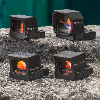
Canik announced the official launch of CANIK OPTICS, featuring four pistol-mounted red dot sights across two families: ONYX and PHANTOM. The new lineup includes the ONYXc micro sight, ONYX XL competition sight, PHANTOMc enclosed micro sight, and PHANTOM duty sight, all engineered to deliver Canik's standard of performance, innovation, and value.
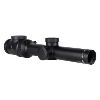
Trijicon introduces a new Standard Green Duplex reticle option for its AccuPoint 1-8x24 riflescope, featuring the company's battery-free tritium and fiber-optic illumination system. The versatile 1-8x magnification scope is designed for hunters and shooters preferring traditional duplex reticles with reliable performance across varying lighting conditions.
Primary Arms announced the promotion of Robert Sheets to Vice President of Engineering. In this role, Sheets will lead the company's optics engineering division and work with the Product Development Team to develop innovative products that meet market and customer demands.
Steiner Optics has added the MPS 2.0 pistol sight to its Steiner Overwatch Program, offering special pricing on precision optics to qualified military, law enforcement, first responders, and judicial personnel. The MPS 2.0 features an enclosed emitter micro red dot with extended runtime up to 90,000 hours and waterproof design for extreme conditions.
Trijicon, Inc. announces six night sight configurations for the Springfield Armory Echelon pistol, including HD, HD XR, and suppressor-height options. These self-luminous sights feature photoluminescent paint and tritium technology, providing enhanced visibility and durability for optics-ready platforms.
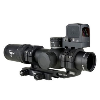
Trijicon announces the new Credo 1-10x28 and RCR Combo, combining two proven optics with Q-LOC mounting technology for close-range speed and extended-distance precision. The system features a first focal plane dual red/green illuminated reticle and ruggedized closed-emitter red dot for extreme durability.
Trijicon announces new MRAD reticle offerings for its ACOG line in 4x32 and 3.5x35 configurations, developed through customer feedback. The flexible aiming solution allows users to establish precise elevation and wind holds across different firearm platforms, calibers, and ammunition types.
Bass Pro Shops announced plans for a new 110,000-square-foot destination retail location in Irmo, South Carolina, expected to open in late 2027. The store will mark Bass Pro Shops' fourth destination retail location in South Carolina and is expected to employ over 120 Outfitters to serve the greater Columbia region near Lake Murray.
There is an incredible number of new optics brands showing up every day now. You can hardly open social media without seeing a previously unknown optics company vying for your attention. As someone who enjoys testing rifles and optics, I’ve made it my mission to get behind as many of these products as possible and see what they offer shooters.
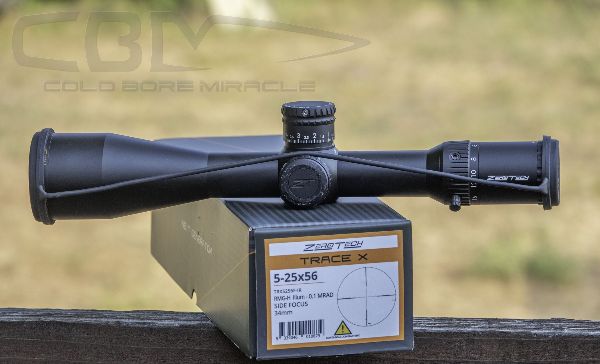
That’s why I took a look at the ZeroTech Trace X 5-25×56 riflescope. Building on the company’s Trace line, the Trace X brings together many of the features precision rifle shooters are looking for, all at a price that deserves attention.
I had several months to test this scope with various calibers and host rifle options. This has given me the chance to get quite comfortable and familiar with the Trace X.
ZeroTech has been around since 2018, but the team behind the company brings decades of experience in optics design and engineering. Originally established in Australia, ZeroTech has expanded into shooting optics markets in various parts of the world.
The company offers a variety of optics, including riflescopes, binoculars, spotting scopes, and red dot sights. With manufacturing facilities in Japan and China, its lineup covers everything from premium optics to more affordable options.
The configurable throw lever with its dual locations
The Trace X is built around a 34mm main tube, a configuration that’s become popular among precision rifle shooters. It uses a 56mm objective lens and offers 5-25X magnification, giving it the versatility needed for everything from closer-range target work to shooting at extended distances. The scope is constructed from 6061-T6 aluminum, and I appreciate the all-metal construction. There aren’t any unnecessary rubber or plastic features to worry about damaging during normal use.
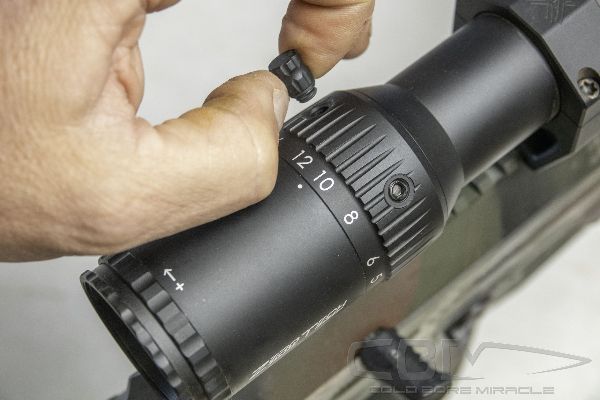
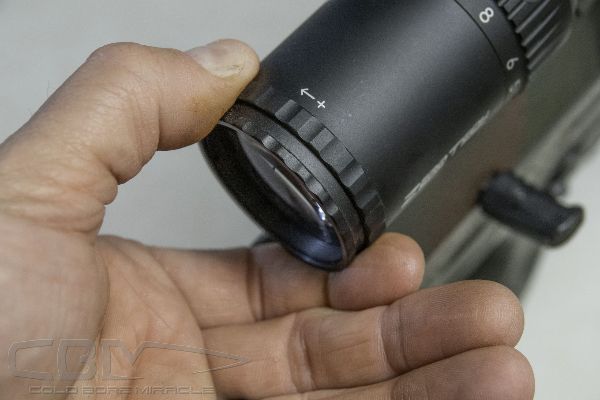
The magnification ring comes with a removable throw lever and ZeroTech provides two mounting positions to help keep it stay clear of bolt handles and the shooter’s fingers. The diopter adjustment has a metal locking ring, allowing you to secure the ocular focus once it’s been set.
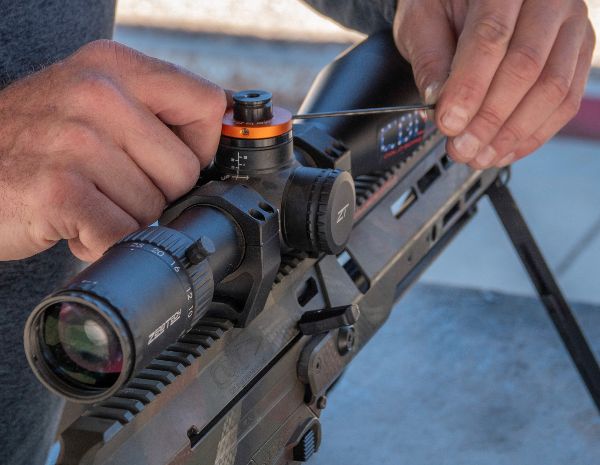
Setting the zero-stop is easy…no mushy soft zero here
The elevation turret above the erector housing and provides 10 MILs per revolution, with adjustments in 0.1-MRAD increments (an MOA version is also available). Removing the turret cap by loosening its two Allen screws reveals the zero-stop mechanism. It uses a substantial aluminum ring that can be positioned to establish your preferred stopping point. The scope has approximately 33 to 34 MRAD of internal elevation adjustment, depending on the specification cited, spread across three revolutions.
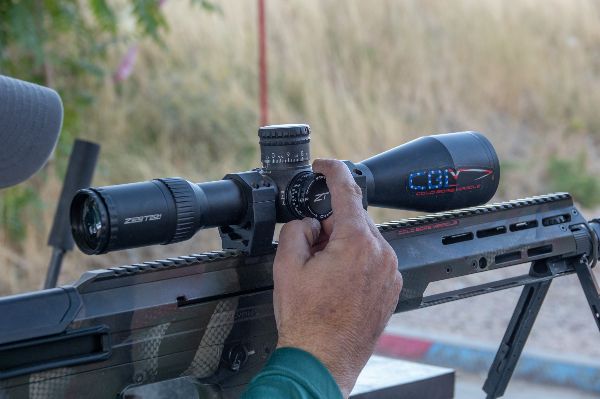
The windage turret is capped, which is something I appreciate. I rarely dial windage outside of the initial zeroing process, so there’s little reason for me to leave that dial exposed. Like the elevation turret, it provides 10 MRAD per revolution, with directional markings indicating right or left adjustment.
Opposite the windage turret is the battery housing and push-button control for the illuminated reticle. These controls sit above the parallax adjustment, giving the scope a clean, well-organized appearance. Parallax adjustment covers a broad range, from 20 meters to infinity, which provides plenty of flexibility for different shooting distances.
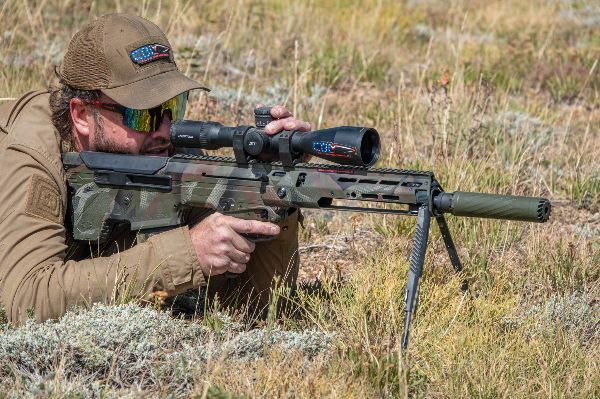
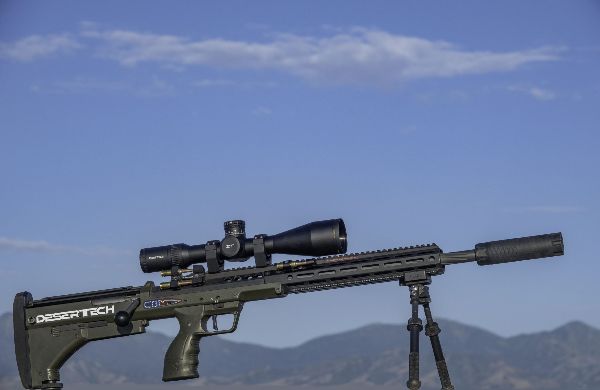
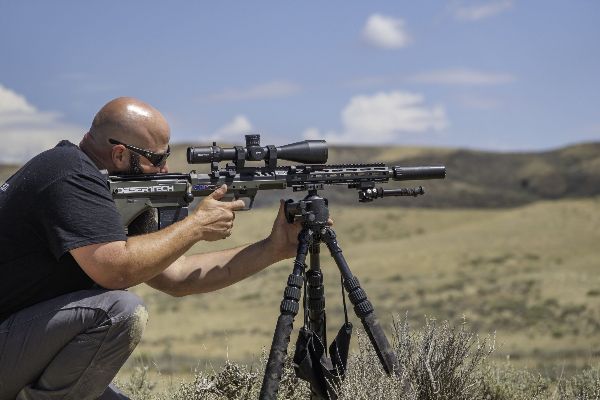
The SRS M2 is a multi-caliber precision rifle, seen here with the Trace X and the WPA Romulus suppressor
For my initial testing, I planned to mount the Trace X on my Desert Tech SRS M2. This is one of my favorite rifles, and its accuracy and repeatability make it an excellent platform for evaluating optics. The rifle has a 30-MOA canted rail, and I paired it with a set of Vortex rings that provided the mounting height I wanted for the ZeroTech scope.
Once everything was mounted, I spent some time looking through the glass and adjusting the magnification. My first impression was that the image was bright and the clarity was very good. Looking across the surrounding landscape and picking out details in trees gave me a positive initial impression. Of course, looking through a scope at the range is only part of the story. I wanted to see how it performed after spending some real time behind it.
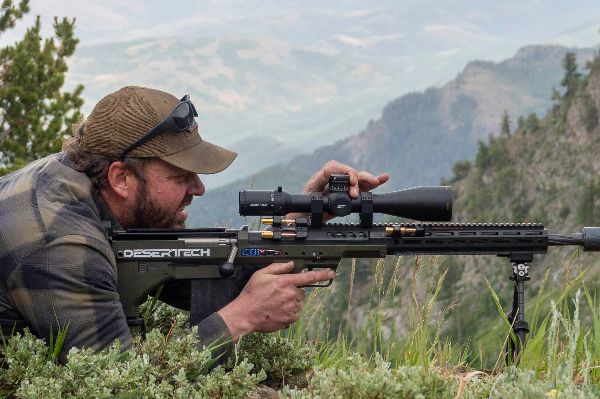
Over the following weeks, I took the Trace X on several range trips and into the mountains. We do plenty of shooting in this country, including chasing squirrels and marmots at high elevations and stretching things out over longer distances. The miles of open country, scattered trees, and brush provide plenty of opportunities to evaluate an optic in conditions that are a little more demanding than a controlled bench session.
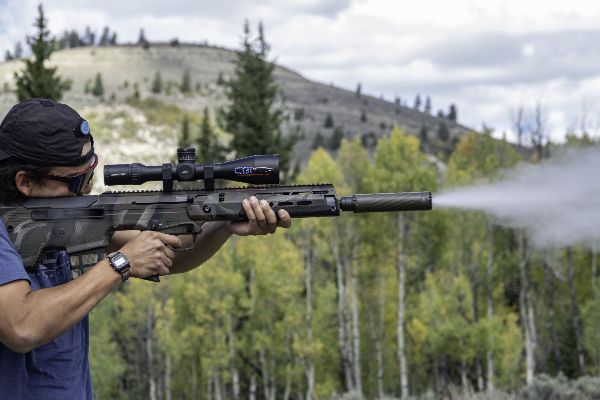
My SRS was equipped with a 6 GT barrel for much of this testing. I know this rifle and its capabilities well, and I have years of reliable ballistic data from shooting it with other quality scopes. That familiarity made it easier to judge the Trace X without having to wonder whether a problem was coming from the rifle, ammunition, or optic. I would also swap out the barrel for my .223, another very accurate and reliable option in the SRS. And additional test was also done using my Desert Tech WLVRN chambered in 6.5 Creedmoor.
The windage turret can be run covered with a cap or left open.
My first trip was to the range, where I got zeroed and checked the tracking and zero-stop functions. Most of this was done at 100 yards. I shot groups, verified the mounting hardware, and made sure everything was secure before moving on to more practical shooting. Once I was satisfied with the rifle’s performance and the scope’s adjustments, it was time to get out into the mountains.
Summer around here provided a surprising variety of conditions. I was able to evaluate the scope in triple-digit heat, where mirage can make identifying distant targets difficult. We also had clouds, rain, and even some frozen precipitation at around 9,000 feet. Later in the season, smoke and haze from distant wildfires provided another challenge for the glass.
The Desert Tech WLVRN in 6.5CM also made a great host for the Trace X.
These conditions aren’t all that different from what any hunter might encounter during a deer or elk season in the mountains. Weather and lighting rarely cooperate perfectly, and I like to see how equipment performs when conditions aren’t ideal. A scope that looks great on a sunny afternoon at the range still needs to perform when the light fades or the atmosphere gets in the way.
ZeroTech uses German Schott glass in the Trace X, and my experience with the scope was encouraging. The image was bright, and details remained sharp. Whether I was looking at the ragged edges of bullet holes in paper or trying to pick out the hair on small animals moving through the landscape, the scope provided a clear image that made identifying details relatively easy.
The broad parallax adjustment range also proved useful. It was easy to work the focus until the image was sharp and the reticle was properly aligned with the target. I spent time behind the scope in early morning light, as the sun came up, as well as under cloudy and smoke-filled skies. Across those conditions, the Trace X delivered optical performance that impressed me for its price.
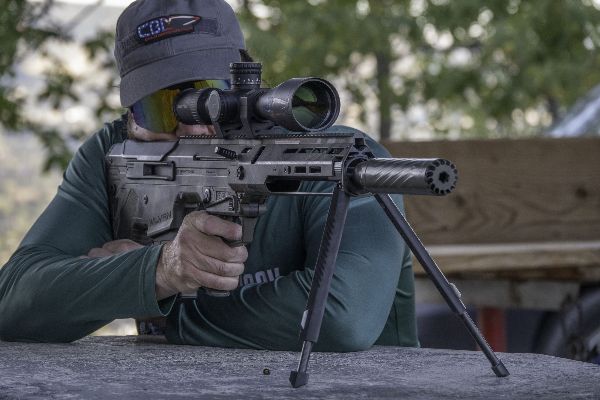
Looking through mirage in the desert with the Trace X
Shooters who have been around precision optics for a while will understand why this matters. Not that long ago, getting this kind of image quality often meant spending two or three times as much on a riflescope. The market has changed considerably, and competition among manufacturers has made capable optics more accessible. The Trace X is another example of that trend.
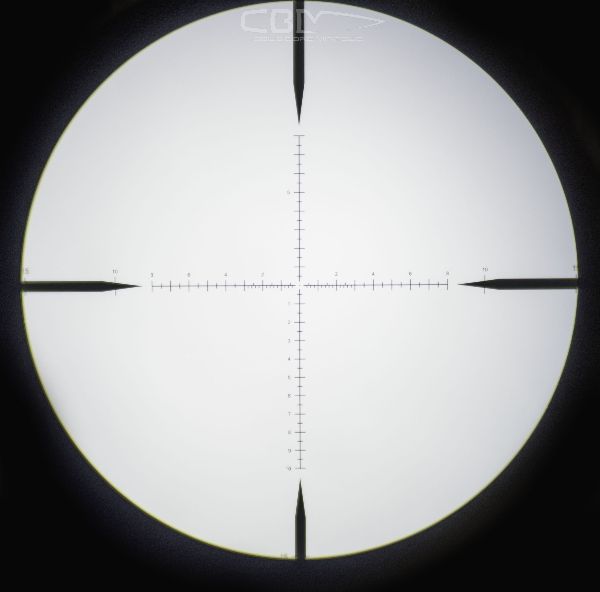
The reticle is another important part of the equation, and ZeroTech offers several options in the Trace X lineup. The RMG-H reticle I used provides a useful balance of reference marks without filling the sight picture with unnecessary detail. Shooters who prefer a more elaborate Christmas-tree-style reticle may want to look at the RMG 3 option instead.
The RMG-H reticle
The RMG-H provides elevation markings at half- and whole-MIL intervals, numbered from one to ten. Windage references are marked in 0.2- and 0.5-MIL increments through the first three MILs, with larger whole- and half-MIL references extending out to eight MILs. The windage numbers are marked at even intervals, and the open center with its aiming dot gives you a clean point of aim without cluttering the target.
Reticle preference is always somewhat subjective. Some shooters want as much information as possible in their field of view, while others prefer a more open design. I found the RMG-H to be a sensible compromise for the kind of precision shooting I do. It provides enough information to make corrections without distracting from the target.
The Trace X also performed well when it came to dialing adjustments. Over the course of the summer, I worked the turrets repeatedly, moved the scope between rifles, established new zeros, and reset the zero-stop as needed. The adjustments remained consistent, and the scope tracked as expected during my testing. It was reassuring to be able to make corrections and return to my established zero without having to second-guess the optic.
The scope also handled the transportation that comes with shooting in the mountains. We spend plenty of time bouncing along rough dirt roads on ATVs, and equipment takes a fair amount of abuse getting from one shooting location to another. The Trace X continued to do its job through those trips and the different shooting sessions that followed.
At an MSRP of $899, the ZeroTech Trace X sits in a competitive part of the optics market. There are plenty of scopes available in this price range, and buyers have no shortage of choices. Still, the Trace X makes a good case for itself with its optical performance, useful reticle, substantial turrets, zero-stop system, and repeatable adjustments.
I was particularly pleased with the clarity of the glass. Even in the heat of summer, when mirage was working against me, I was able to pick out small targets at distance. The turrets provided positive clicks, the zero-stop was straightforward to set, and the wide parallax adjustment range made it easy to get a sharp image. For a precision-oriented riflescope in this price bracket, those are meaningful strengths.
I didn’t realize how nice having a lock ring on the ocular adjustment was until I found myself re-focusing other scopes.
I did encounter one minor annoyance with the reticle illumination. On one occasion, I transported the rifle in a soft case and later discovered that the illumination had switched on. I’m not sure whether I accidentally pressed the button while putting the rifle into the case or whether it was bumped during transport. Either way, I was surprised to find the reticle glowing red when I got to the firing line. It’s a relatively small issue, but it’s worth being aware of if you routinely transport a rifle in a soft case.
After several months of using the Trace X in a variety of shooting situations, I’ve come away impressed. The scope gave me the opportunity to compare it with several other optics I regularly use, and it reinforced just how much the riflescope market has changed. Not long ago, getting a reliable precision optic with good glass, dependable tracking, an illuminated reticle, and a functional zero-stop meant spending considerably more money.
The ZeroTech Trace X 5-25×56 demonstrates that shooters no longer need to spend a thousand dollars or two to get a capable precision riflescope. It offers the features I want, performed well throughout my testing, and delivered optical clarity that exceeded what I would have expected at this price. There is certainly no shortage of competition in the market, but ZeroTech has put together an appealing package with the Trace X. Based on my experience, I expect the company will continue to attract attention from shooters looking for performance without the premium price tag.